
Every time a visitor lands on your site, you face a choice: collect everything possible and hope for insights, or collect only what you need and respect privacy by design.
Privacy-first analytics takes the second approach. It’s not about tracking less — it’s about tracking smarter, without the legal risks, consent friction, and data quality problems that come with surveillance-based tools.
In this guide, I’ll explain what privacy-first analytics actually means in practice, why it often produces better data than invasive tracking, and how to implement it without losing the insights you need.
What Is Privacy-First Analytics?
Privacy-first analytics collects website data while minimizing personal information and respecting user privacy. The core principles:
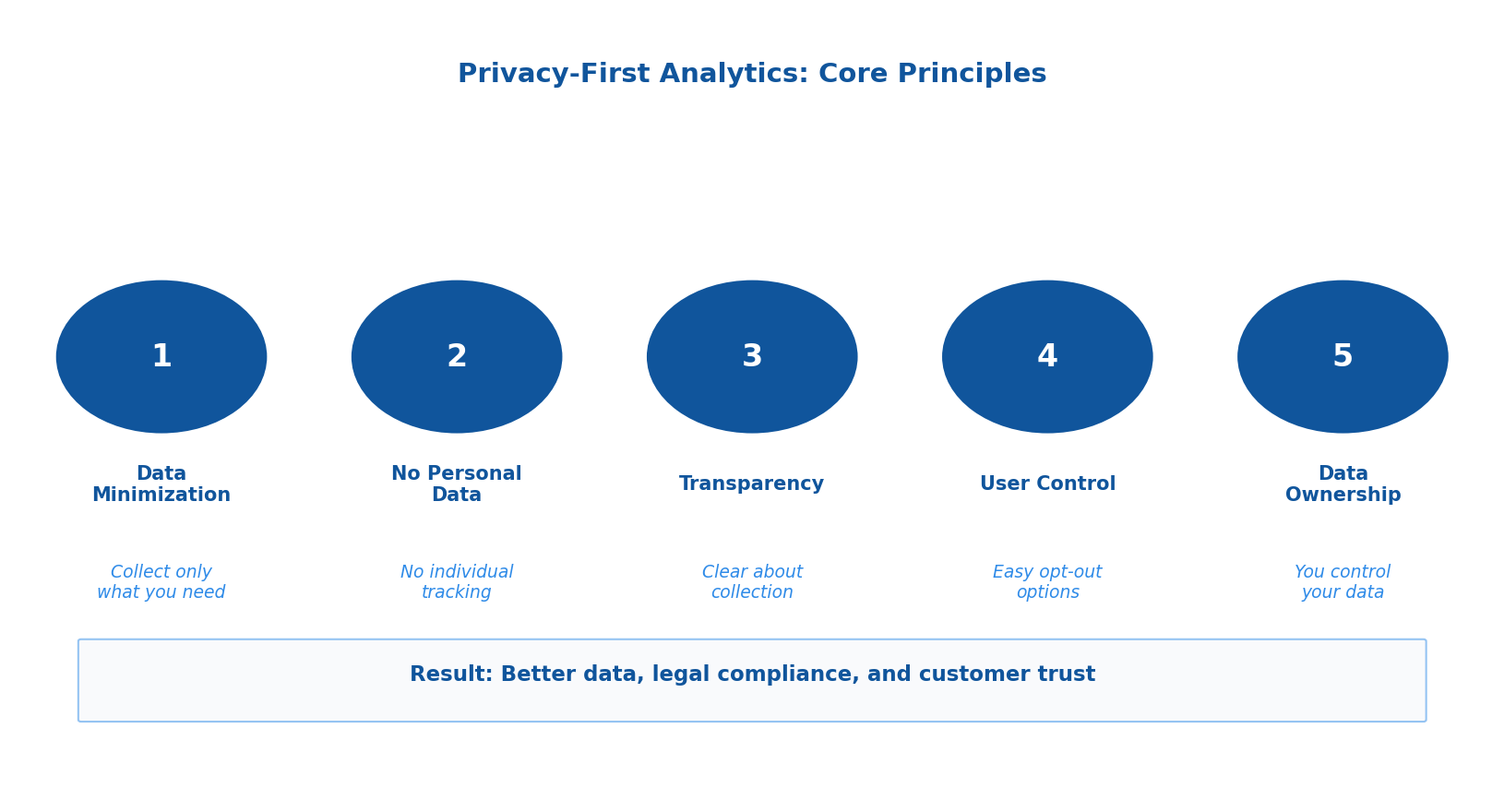
- No personal data by default: No tracking of individuals across sites, no building user profiles for advertising
- Data minimization: Collect only what’s necessary for your analysis goals
- Transparency: Clear about what you collect and why
- User control: Easy opt-out, respect for browser privacy settings
- Data ownership: You control your data, not a third-party platform
This isn’t just ethics — it’s increasingly a legal requirement and a business advantage.
The Problem with Traditional Analytics
Google Analytics dominates web analytics with over 80% market share. But that dominance comes with significant trade-offs:
Data Ownership Issues
When you use Google Analytics, Google processes your visitor data. Their privacy policy allows combining this data with information from other Google services, potentially for advertising purposes and AI model training. You’re giving away insights about your customers to a company that also sells advertising.
Legal Exposure
Multiple European data protection authorities have ruled Google Analytics non-compliant with GDPR:
- Austria (2022): Austrian DPA ruled GA transfers to US violate GDPR
- France (2022): CNIL ordered websites to stop using GA
- Italy (2022): Garante issued similar ruling
- Germany (2025): Cologne court confirmed GA violates data transfer requirements
While Google has made changes (EU data residency, consent mode), the fundamental architecture — sending user data to a US company — remains a compliance risk for EU businesses.
Consent Friction Destroys Data Quality
Here’s the irony: privacy regulations designed to protect users have made traditional analytics worse at its job.
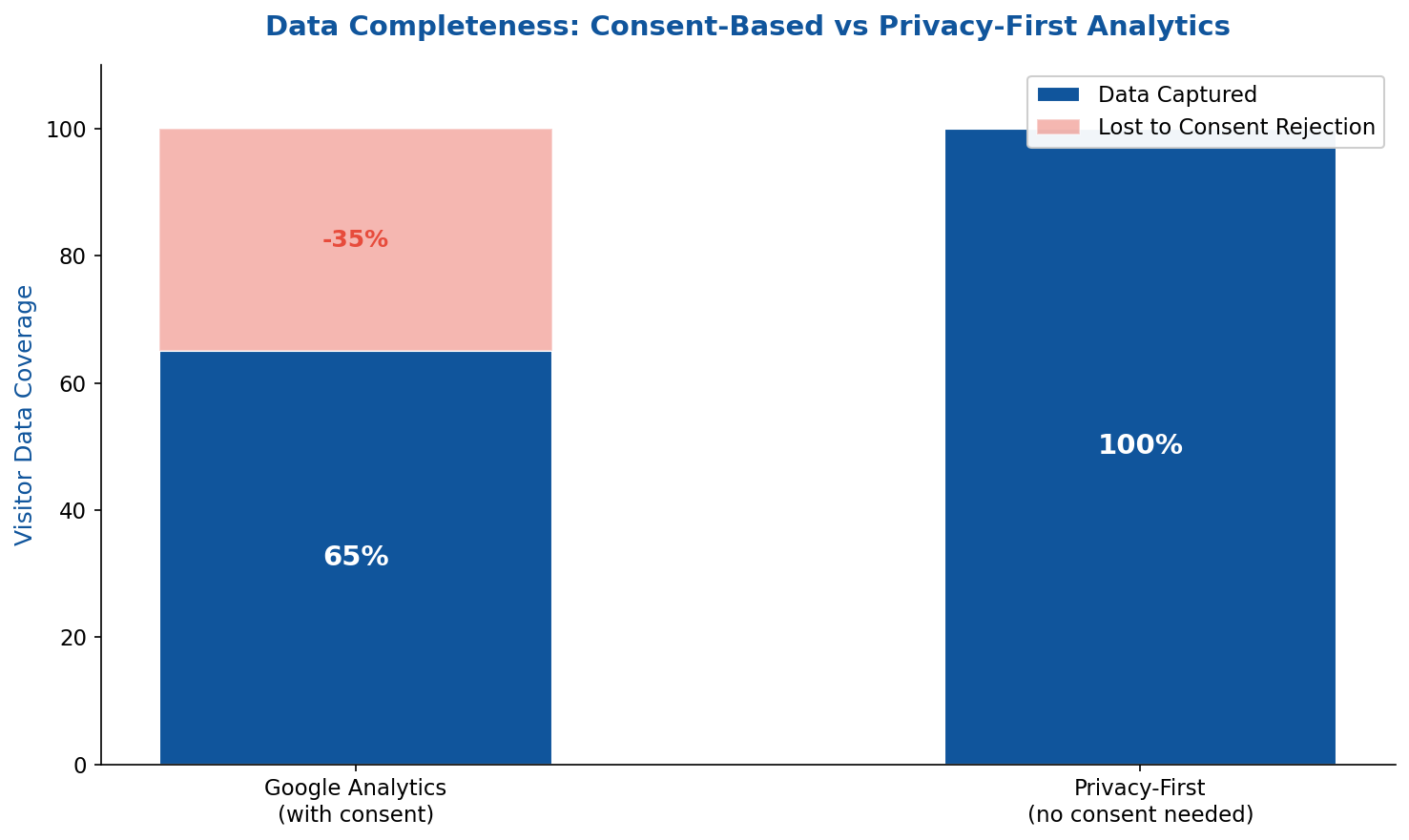
When you require cookie consent for Google Analytics:
- 20-40% of visitors decline or ignore the banner
- Your traffic data undercounts by that same percentage
- Conversion attribution breaks when the same user accepts cookies on one visit but not another
- Geographic and demographic data becomes unreliable
Privacy-first tools that don’t require consent can actually capture more complete data than consent-dependent alternatives.
When You Need Consent vs. When You Don’t
Not all analytics require cookie consent. Understanding the distinction is crucial:
Consent Required
- Third-party cookies (cross-site tracking)
- Persistent identifiers for user profiling
- Data shared with third parties for their purposes
- Advertising-related tracking
- Analytics that identify individual users across sessions
Consent Often Not Required
- First-party, session-only analytics
- Aggregate statistics without individual identification
- Strictly necessary cookies (authentication, security)
- Analytics where data stays on your servers with no third-party access
The French data protection authority (CNIL) specifically approved Matomo for consent-free use when properly configured. Several other privacy-first tools meet similar criteria.
This doesn’t mean you can skip privacy considerations — you still need a clear privacy policy and legitimate interest basis. But you can often avoid the consent banner that kills data completeness.
Privacy-First Analytics Tools Compared
The market has matured significantly. Here’s how the leading options compare:
| Tool | Hosting | Consent-Free | Best For | Pricing |
|---|---|---|---|---|
| Matomo | Self-hosted or Cloud | Yes (configured) | Full GA replacement, advanced features | Free (self) / €19+/mo |
| Plausible | EU Cloud or Self-hosted | Yes | Simple, lightweight, developer-friendly | $9+/mo / Free (self) |
| Fathom | Cloud (US/EU) | Yes | Simple dashboard, excellent UX | $14+/mo |
| Umami | Self-hosted or Cloud | Yes | Open-source, self-hosting priority | Free (self) / $9+/mo |
| Simple Analytics | EU Cloud | Yes | Minimalist, tweet-sized script | $9+/mo |
| PostHog | Cloud or Self-hosted | Configurable | Product analytics + web analytics | Free tier / Usage-based |
For detailed feature comparisons, see our complete guide to Google Analytics alternatives.
Choosing Based on Your Needs
Need full GA feature parity? → Matomo (goals, funnels, e-commerce, heatmaps, A/B testing)
Want maximum simplicity? → Plausible or Fathom (clean dashboards, essential metrics only)
Technical team, want full control? → Umami or Matomo self-hosted
Need product analytics too? → PostHog (combines web + product analytics)
EU data residency required? → Plausible, Fathom EU, or any self-hosted option in EU
What You Lose (and What You Don’t)
Privacy-first analytics involves trade-offs. Here’s an honest assessment:
What You Typically Lose
Cross-site user tracking: You can’t follow users across domains you don’t own. For most businesses, this is fine — and for users, it’s the point.
Google ecosystem integration: No automatic connection to Google Ads, Search Console integration varies. You’ll need to build cross-channel analytics deliberately.
Demographic data: Privacy-first tools don’t infer age, gender, or interests. If you need this, you’ll need to collect it directly (surveys, account data).
Long-term user journeys: Without persistent identifiers, tracking the same user over months is limited. You can still do session-level and short-term analysis.
What You Keep (Or Gain)
Traffic sources and campaigns: UTM tracking works identically. You’ll see where visitors come from.
Page performance: Views, time on page, scroll depth, bounce rates — all available.
Conversions and goals: Track form submissions, purchases, signups. E-commerce tracking available in Matomo and others.
Real-time data: Most privacy-first tools offer real-time dashboards.
Complete data: No consent dropoff means 100% of traffic counted, not 60-80%.
Data ownership: Export everything. No vendor lock-in. Your data on your terms.
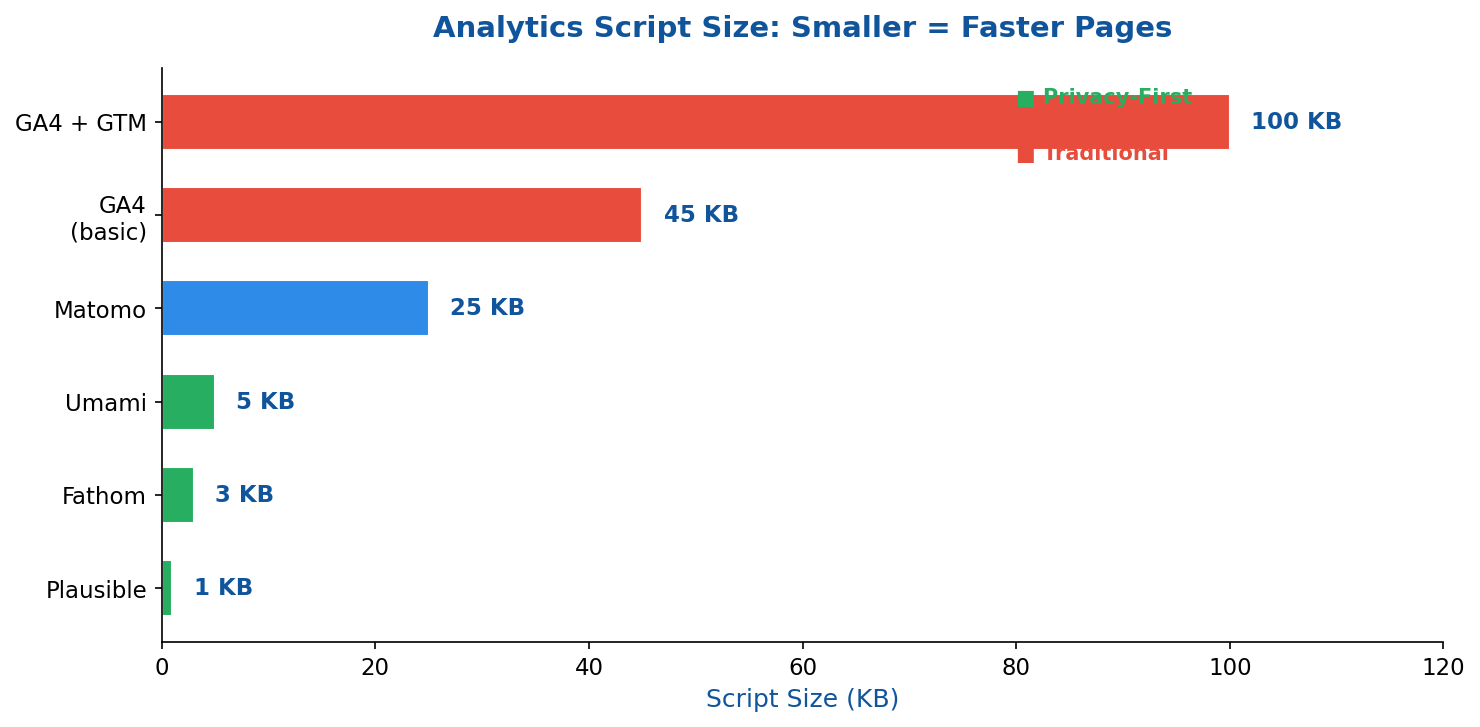
Page speed: Privacy-first scripts are typically 1-25KB vs. Google Analytics at 45KB+. Faster sites, better Core Web Vitals.
Implementation: How to Switch
Step 1: Audit Current Tracking
Before switching, document what you’re currently tracking:
- What goals and conversions are configured?
- What custom events do you track?
- Which reports do stakeholders actually use?
- What integrations depend on analytics data?
Most teams discover they use 20% of available features. Focus your migration on what matters.
Step 2: Run Parallel Tracking
Don’t switch overnight. Run your new privacy-first tool alongside existing analytics for 2-4 weeks:
- Compare traffic numbers (expect privacy-first to be higher due to no consent loss)
- Verify conversion tracking works
- Confirm UTM parameters pass through correctly
- Check that key pages and events are captured
Step 3: Configure for Consent-Free Operation
To operate without consent banners, configure your tool properly:
For Matomo:
- Enable IP anonymization (last 2 bytes)
- Disable User ID feature
- Set cookie expiration to session or short duration
- Enable “Respect DoNotTrack” preference
- Host in EU if serving EU visitors
For Plausible/Fathom/Umami:
- These are consent-free by default — no configuration needed
- Just add the script and you’re compliant
Step 4: Update Privacy Policy
Even without consent requirements, you need transparency:
- Describe what analytics you collect
- Explain the purpose (website improvement)
- Note that data isn’t shared with third parties
- Provide opt-out mechanism (most tools support this)
- Identify your legal basis (legitimate interest for consent-free; consent if required)
Step 5: Remove Old Tracking
Once validated, remove Google Analytics or other legacy tracking:
- Remove gtag.js or analytics.js scripts
- Remove Google Tag Manager if only used for GA (or reconfigure)
- Remove cookie consent banner if no longer needed
- Update any documentation referencing old analytics
Privacy-First and Marketing Attribution
A common concern: “How do I attribute conversions without user tracking?”
Privacy-first analytics handles attribution differently:
What Works
UTM-based attribution: First-touch and last-touch attribution via URL parameters works perfectly. Most privacy-first tools track original referrer and landing page.
Session-level journeys: You can see the path within a single session — which pages led to conversion.
Campaign performance: Track which campaigns drive traffic and conversions using UTM parameters.
What’s Different
Multi-session attribution: Without persistent user IDs, connecting Tuesday’s ad click to Saturday’s purchase is harder. Solutions:
- Use logged-in user tracking (with consent) for registered users
- Rely on first-party data from CRM to connect journeys
- Accept that some attribution will be session-based
Cross-device tracking: Privacy-first tools don’t connect phone browsing to desktop purchase. For most businesses, this matters less than they think — and the complete session data compensates.
The Business Case: Why Privacy-First Often Wins
Beyond compliance, privacy-first analytics can improve your actual results:
More Complete Data
When 30% of visitors reject cookie consent, your data is 30% wrong. Every metric — traffic, conversion rates, attribution — is skewed. Privacy-first tools that don’t require consent capture everyone.
Faster Pages
Plausible’s script is under 1KB. Fathom is under 3KB. Google Analytics with Tag Manager can exceed 100KB. Faster pages mean better user experience and higher conversions.
Reduced Legal Risk
GDPR fines can reach €20 million or 4% of global revenue. Even without fines, responding to data protection complaints costs time and money. Privacy-first tools reduce this exposure.
Customer Trust
Cisco research found 94% of customers won’t buy from companies they don’t trust with their data. A privacy-respecting approach is increasingly a competitive advantage, especially in B2B and sensitive industries.
Simpler Stack
No consent management platform. No cookie banner A/B testing. No complex GTM configurations. Less time managing compliance, more time analyzing data.
Common Objections Addressed
“We need Google Ads integration”
You can still use Google Ads without Google Analytics. Import conversions via the Google Ads API, or use offline conversion tracking. The advertising platform doesn’t require the analytics platform.
“Our team only knows Google Analytics”
The learning curve is minimal. Matomo’s interface deliberately mirrors GA. Simpler tools like Plausible can be learned in an hour. The concepts (sessions, pageviews, conversions) are identical.
“We need historical data”
Matomo can import historical Google Analytics data. For simpler tools, you’ll start fresh — but your historical GA data remains accessible in Google’s interface for reference.
“Self-hosting is too complex”
All major privacy-first tools offer managed cloud hosting. Self-hosting is an option, not a requirement. Cloud-hosted Plausible or Fathom is literally one line of code to implement.
“We can’t lose any features”
Matomo offers feature parity with GA, including funnels, e-commerce, heatmaps, and session recordings. If you need everything GA offers, Matomo delivers it with full data ownership.
Implementation Checklist
Ready to switch? Here’s your action plan:
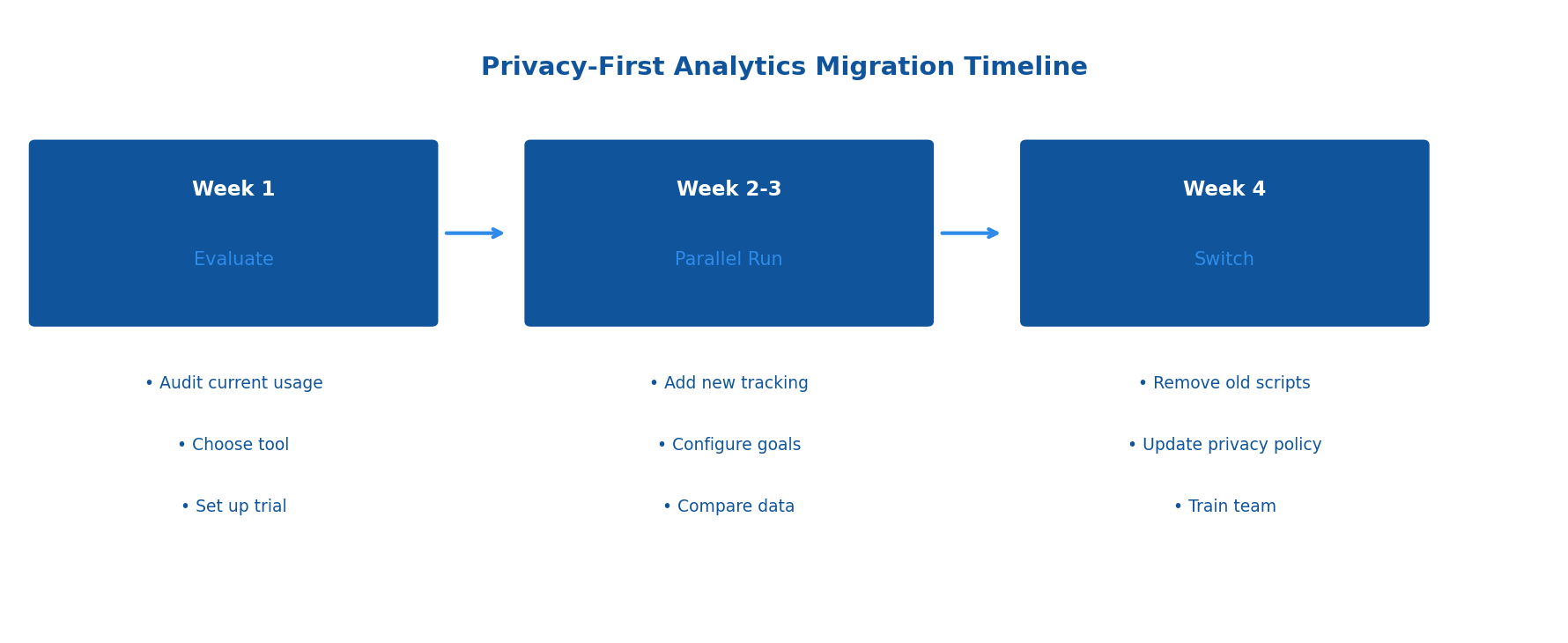
Week 1: Evaluate
- Audit current analytics usage (what reports matter?)
- List must-have features
- Choose a tool based on needs
- Sign up for trial or set up self-hosted instance
Week 2-3: Parallel Run
- Add new tracking script alongside existing
- Configure goals and conversions
- Set up UTM tracking consistency
- Compare data between tools
Week 4: Switch
- Validate data accuracy
- Update privacy policy
- Remove old tracking scripts
- Remove consent banner (if applicable)
- Train team on new interface
Key Takeaways
- Privacy-first analytics isn’t about less data — it often captures more complete data by avoiding consent dropoff
- Legal compliance is just the start — faster sites, simpler stacks, and customer trust are real business benefits
- You don’t lose essential features — traffic, conversions, campaigns, and attribution all work; only cross-site user profiling is removed
- Migration is straightforward — parallel tracking for 2-4 weeks validates the switch before committing
- Tools have matured — Matomo, Plausible, Fathom, and Umami are production-ready for businesses of any size
The surveillance-based analytics model was never sustainable. Regulations caught up, browsers cracked down, and users started blocking. Privacy-first analytics isn’t a compromise — it’s the path forward for reliable, ethical measurement.