Your customer clicked a Facebook ad, read two blog posts, opened an email, and finally converted through a Google search. Which channel gets credit for the sale?
With linear attribution, the answer is simple: all of them, equally. Each touchpoint receives the same percentage of conversion credit, regardless of when it occurred or what role it played.
This simplicity is both linear attribution’s greatest strength and its biggest limitation. In this guide, I’ll explain how the linear model works, when it makes sense to use it, and when you should choose a different approach.
What Is the Linear Attribution Model?
The linear attribution model is a multi-touch attribution method that distributes conversion credit equally across every touchpoint in the customer journey. If a customer interacted with four channels before converting, each channel receives 25% credit.
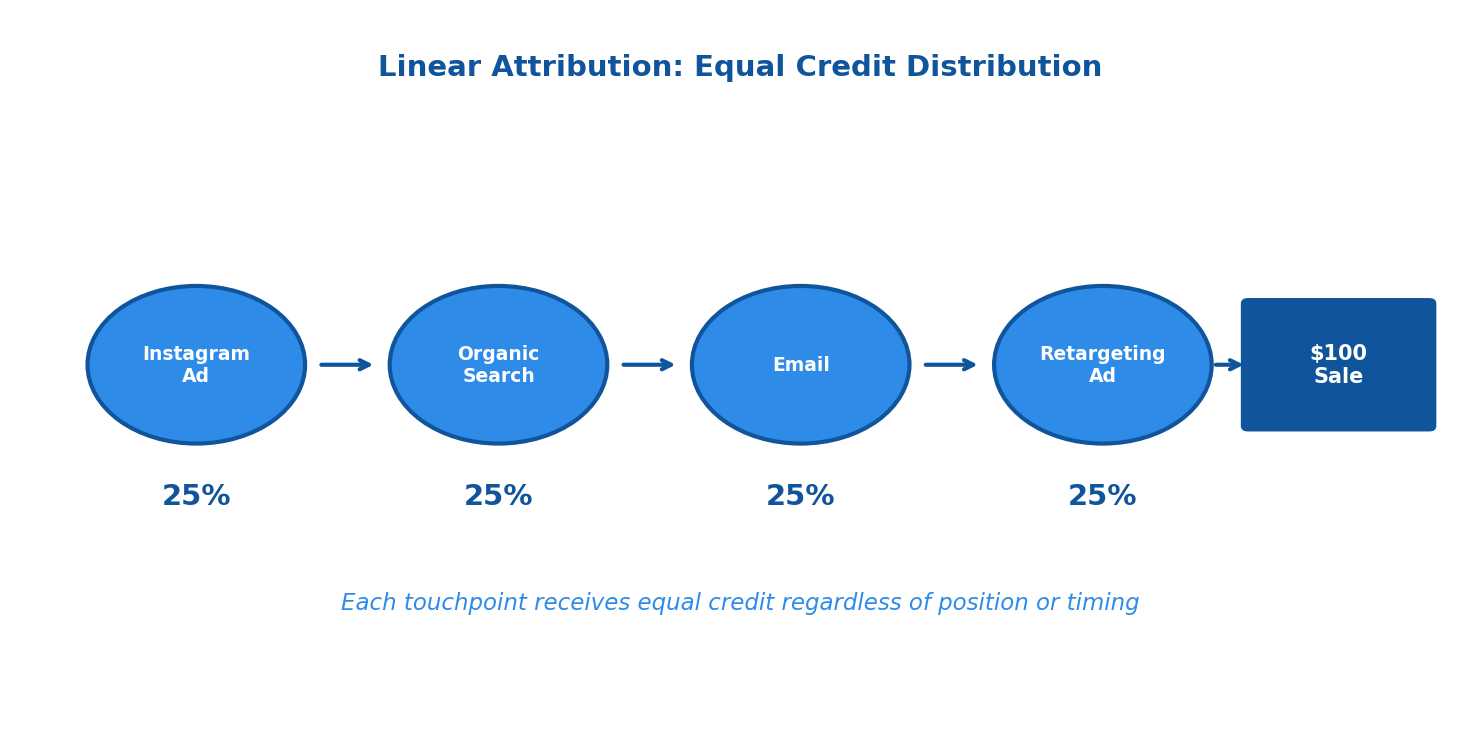
Here’s a practical example:
Customer journey:
- Sees Instagram ad (awareness)
- Clicks Google organic result (research)
- Opens email newsletter (nurture)
- Clicks retargeting ad (conversion)
With linear attribution:
- Instagram ad: 25% credit
- Google organic: 25% credit
- Email: 25% credit
- Retargeting ad: 25% credit
Compare this to last-click attribution, where the retargeting ad would receive 100% credit — making Instagram, organic search, and email appear worthless despite their role in the journey.
How Linear Attribution Compares to Other Models
Linear attribution is one of several multi-touch models. Understanding the differences helps you choose the right approach for your business.
| Model | Credit Distribution | Bias | Best For |
|---|---|---|---|
| Last-Click | 100% to final touchpoint | Conversion-focused | Short sales cycles, direct response |
| First-Click | 100% to first touchpoint | Acquisition-focused | Brand awareness measurement |
| Linear | Equal across all touchpoints | None (neutral) | Balanced view, simple analysis |
| Time-Decay | More credit to recent touchpoints | Bottom-funnel | Long B2B cycles, late-stage optimization |
| Position-Based (U-Shaped) | 40% first, 40% last, 20% middle | Intro + conversion | Valuing discovery and closing equally |
| Data-Driven | ML-determined weights | Learns from your data | High-volume, sophisticated tracking |
Linear attribution’s neutrality is intentional. Unlike position-based or time-decay models, it makes no assumptions about which touchpoints matter more. This can be an advantage — or a blind spot.
Linear Attribution: Visual Example
Let’s see how a $100 conversion gets attributed across the same five-touchpoint journey using different models:
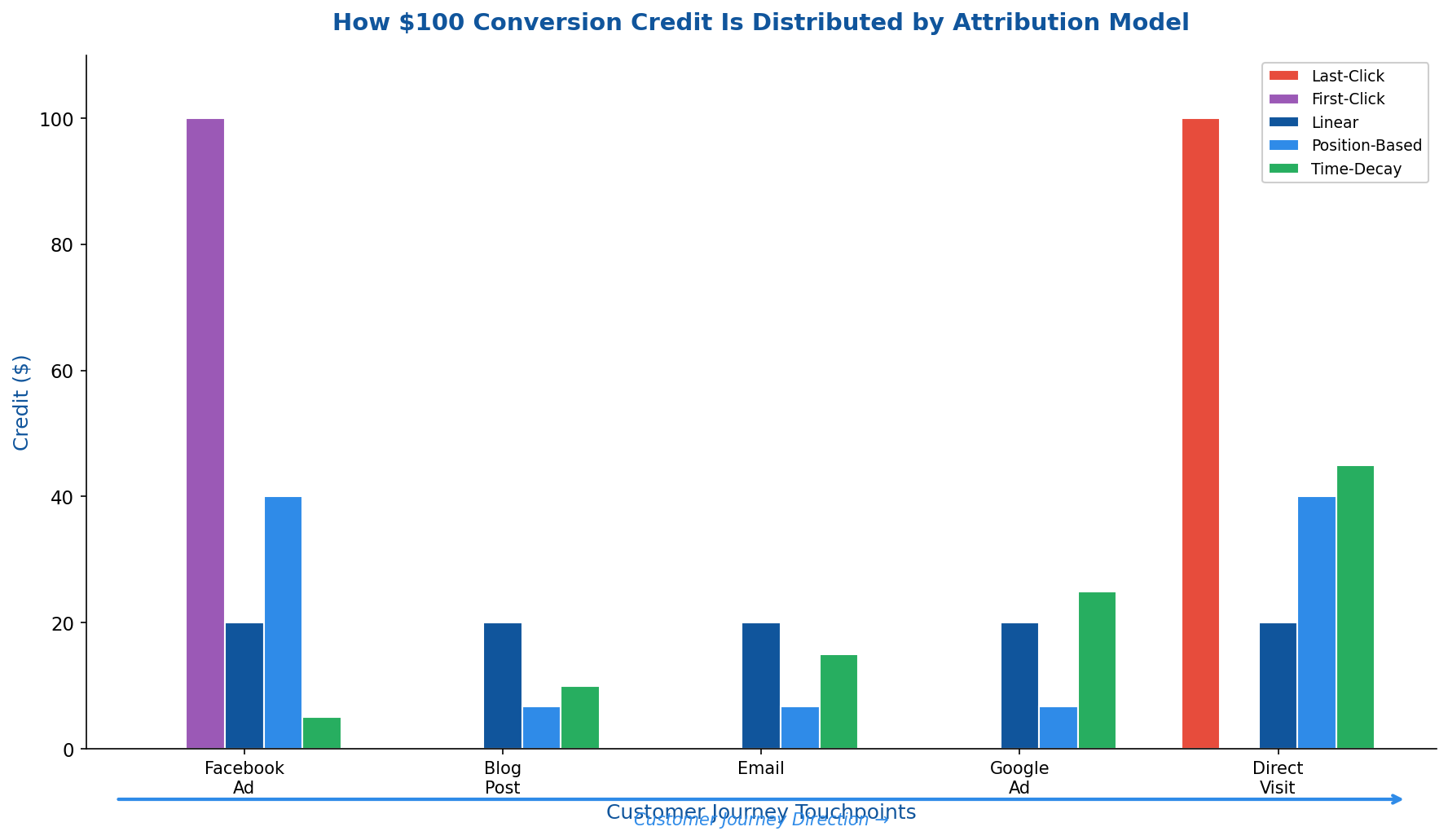
Notice how linear attribution gives every channel equal recognition. This prevents any single touchpoint from being over- or under-valued — but it also treats the initial Facebook ad the same as the final direct visit, even though they likely played very different roles.
When to Use Linear Attribution
Linear attribution works well in specific situations:
1. Short, Multi-Touch Sales Cycles
If customers typically interact with 3-6 touchpoints over days (not months), linear attribution provides a reasonable approximation. The equal weighting matters less when touches are close together in time and likely reinforce each other.
Example: E-commerce purchases where customers see an ad, browse the site, and buy within a week.
2. When You’re Starting with Multi-Touch Attribution
Moving from last-click to any multi-touch model is a significant improvement. Linear attribution is the easiest to understand and explain to stakeholders. It’s a good stepping stone before adopting more complex models.
3. When Channels Genuinely Contribute Equally
Some businesses have marketing mixes where every touchpoint truly plays a similar role — consistent brand reinforcement across channels rather than distinct funnel stages. In these cases, linear attribution accurately reflects reality.
4. When You Need Simplicity for Reporting
If you’re reporting to executives who need intuitive metrics, linear attribution is easy to explain: “Each touchpoint gets equal credit.” No complex weighting explanations required.
5. When You Want to Avoid Over-Crediting Closers
Last-click attribution consistently over-credits bottom-funnel channels (branded search, retargeting, email). Linear attribution corrects this by ensuring awareness and consideration channels get recognition.
When NOT to Use Linear Attribution
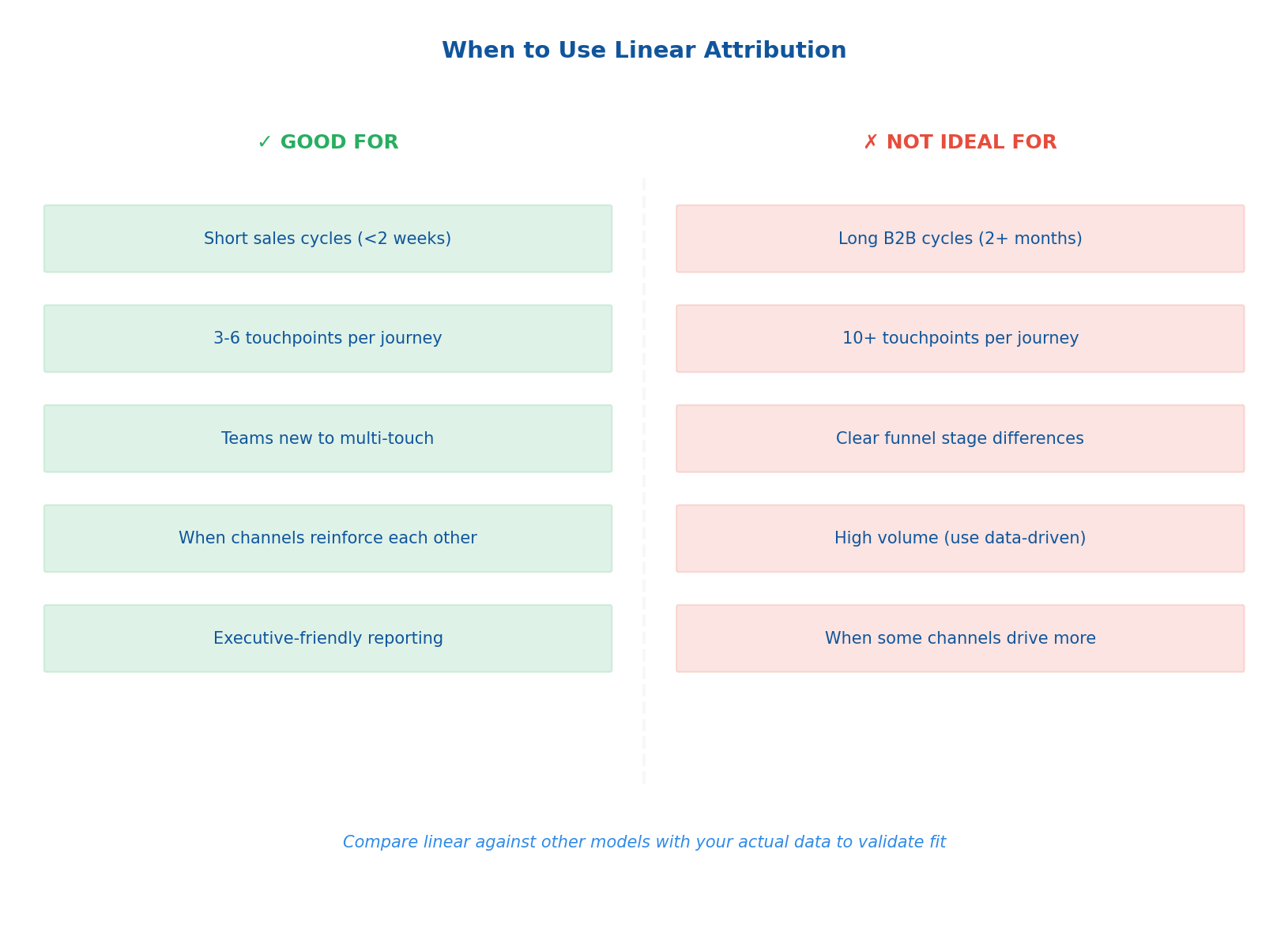
Linear attribution has real limitations. Avoid it when:
1. You Have Long, Complex Sales Cycles
B2B sales with 20+ touchpoints over months don’t benefit from equal weighting. A blog post read six months ago shouldn’t receive the same credit as a demo request last week. Time-decay or data-driven models handle this better.
2. Your Funnel Stages Have Clear, Different Purposes
If your marketing clearly separates awareness (display ads), consideration (content marketing), and conversion (retargeting), these stages likely have unequal impact. Position-based or custom models capture this better.
3. You Need to Optimize Specific Funnel Stages
Linear attribution tells you which channels participate in journeys. It doesn’t tell you which channels are most effective at awareness vs. conversion. For funnel-stage optimization, you need models that differentiate.
4. You Have Sufficient Data for Data-Driven Attribution
If you have high conversion volume (typically 300+ conversions per month), data-driven attribution in GA4 or dedicated tools will outperform any rule-based model, including linear.
5. Some Touchpoints Are Clearly More Influential
If you know (from testing or experience) that certain channels drive incremental conversions while others just appear in paths, equal weighting misrepresents reality.
How Linear Attribution Affects Budget Decisions
Attribution models directly impact how you allocate marketing spend. Here’s how linear attribution changes the picture:
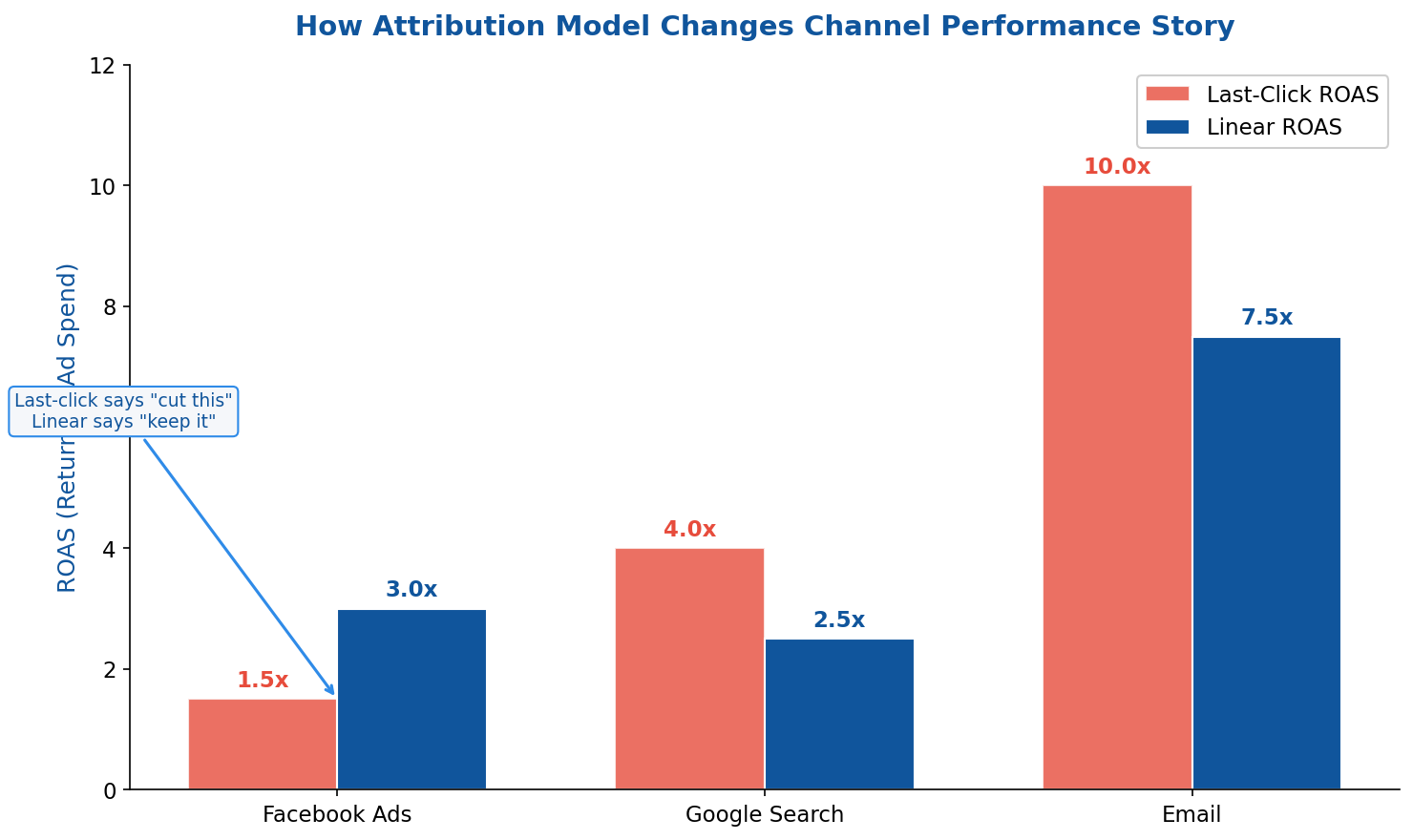
Scenario: Evaluating Channel Performance
Imagine you’re analyzing Q4 performance across three channels:
| Channel | Spend | Last-Click Revenue | Last-Click ROAS | Linear Revenue | Linear ROAS |
|---|---|---|---|---|---|
| Facebook Ads | $50,000 | $75,000 | 1.5x | $150,000 | 3.0x |
| Google Search | $50,000 | $200,000 | 4.0x | $125,000 | 2.5x |
| $10,000 | $100,000 | 10.0x | $75,000 | 7.5x |
Last-click conclusion: Facebook is underperforming (1.5x ROAS). Cut budget and shift to Google Search and Email.
Linear attribution reveals: Facebook actually drives 3.0x ROAS when you credit its role in multi-touch journeys. It’s introducing customers who later convert through other channels. Cutting Facebook might reduce Google Search and Email conversions too.
This is linear attribution’s core value: it prevents you from cutting awareness channels that feed your conversion channels.
Setting Up Linear Attribution
In Google Analytics 4
GA4 defaults to data-driven attribution, but you can compare models:
- Go to Advertising → Attribution → Model comparison
- Select “Linear” from the model dropdown
- Compare against other models to see how credit shifts
Note: GA4 no longer allows changing the default reporting model for standard reports. Linear attribution is available in the comparison tool and explorations, but data-driven remains the primary model.
In Matomo
- Navigate to Goals → Attribution
- Select “Linear” from the attribution model selector
- View reports with linear-attributed conversions
Matomo applies attribution without data sampling, which matters for sites with lower traffic volumes.
In Other Platforms
Most analytics and attribution tools support linear attribution:
- Segment: Available in Personas attribution
- Mixpanel: Supported in attribution reports
- Triple Whale: Included in multi-touch options
- HubSpot: Available in Marketing Hub attribution
For a broader comparison of analytics platforms, see our guide to Google Analytics alternatives.
Linear Attribution and Cross-Channel Analysis
Linear attribution becomes more powerful when combined with cross-channel analytics. Here’s why:
The problem: Each advertising platform (Google, Meta, TikTok) uses its own attribution, typically last-click within their ecosystem. They all claim credit for the same conversions.
The solution: Unified cross-channel tracking with a consistent attribution model (like linear) applied across all channels. This shows actual contribution rather than overlapping platform claims.
When platforms report 500 conversions combined but your actual conversion count is 300, linear attribution across a unified data source shows the true picture — each touchpoint’s proportional contribution to those 300 real conversions.
Linear Attribution in a Privacy-First World
Attribution accuracy depends on tracking completeness. With cookie consent, iOS App Tracking Transparency, and ad blockers, many touchpoints go unrecorded.
Linear attribution is somewhat resilient to this because:
- It doesn’t over-weight any single touchpoint (so missing one touch is less distorting)
- It works with whatever touchpoints you can track
- It doesn’t require the long lookback windows that complex models need
However, all attribution models suffer when tracking is incomplete. Building your analytics on first-party data improves accuracy regardless of which model you use.
Comparing Linear Attribution Results
The best way to evaluate linear attribution is to compare it against other models using your actual data. Look for:
Channels that gain credit under linear:
- Display advertising
- Social media (non-conversion focused)
- Content marketing / organic
- Brand awareness campaigns
Channels that lose credit under linear:
- Branded search
- Retargeting
- Email (especially cart abandonment)
- Direct traffic
If the “losers” are channels you know drive conversions independently (through incrementality tests), linear attribution might be over-correcting. If the “gainers” are channels you suspected were undervalued, linear is likely giving a more accurate picture.
Decision Framework: Is Linear Attribution Right for You?
Answer these questions to decide:
1. How long is your typical sales cycle?
- Under 2 weeks → Linear works well
- 2-8 weeks → Linear is acceptable
- Over 2 months → Consider time-decay or data-driven
2. How many touchpoints in a typical journey?
- 2-5 touchpoints → Linear works well
- 6-10 touchpoints → Linear is acceptable
- 10+ touchpoints → Position-based or data-driven preferred
3. Do your funnel stages have clearly different purposes?
- Stages blur together → Linear works well
- Clear awareness/consideration/conversion split → Position-based may be better
4. What’s your monthly conversion volume?
- Under 300 → Linear (data-driven needs more data)
- Over 300 → Consider data-driven if available
5. Who needs to understand the reports?
- Technical team only → Any model works
- Executives/clients need to understand → Linear is easiest to explain
Key Takeaways
- Linear attribution distributes credit equally across all touchpoints — simple, neutral, easy to understand
- Best for shorter sales cycles with 3-6 touchpoints where channels likely reinforce each other
- Avoid for complex B2B journeys with many touchpoints over long periods — time-decay or data-driven work better
- Core value: Prevents cutting awareness channels that feed your conversion channels
- Core limitation: Treats all touchpoints as equally influential when they rarely are
- Compare models: The best approach is testing linear against other models with your actual data to see which tells a story that matches what you observe
Linear attribution isn’t perfect — no attribution model is. But it’s a significant improvement over last-click for most businesses, and its simplicity makes it a practical starting point for teams moving toward more sophisticated measurement.